
How Many Units Of Botox Are Used For The Forehead?
If you have been researching how many units of Botox for forehead treatments are right for you, you have probably noticed that dosage estimates vary widely online. That is because the right amount depends on your unique anatomy, your goals, and the expertise of the injector guiding your treatment. At SkinLab Ashburn, we help patients understand the basics so you can walk into your consultation feeling informed and confident.
Key Takeaways
-
Men typically need more than women. Larger, stronger frontalis muscles often call for more units, though dosing should be based on your individual muscle activity, not gender alone.
-
Several factors shape your exact dose. Muscle strength, forehead size, line depth, Botox history, brow position, and your desired result all influence the unit count.
-
Precision protects your brows and your look. Too many units can cause a heavy or droopy brow, so a skilled injector and a conservative starting dose help you avoid a frozen appearance. Results show in 3 to 5 days and last 3 to 4 months.
How Botox Works in the Forehead
Botox is a purified neuromodulator derived from botulinum toxin type A. When injected into a targeted muscle, it temporarily blocks the nerve signals that tell that muscle to contract, which softens the lines and creases that form on the skin above it.
In the forehead, the primary muscle responsible for horizontal lines is the frontalis. This broad, flat muscle runs across the entire forehead and lifts the brows when it contracts. Repeated contraction over the years etches those familiar parallel lines into the skin. Botox interrupts that repetitive motion without permanently altering the muscle, which is why results are temporary, and the treatment can be adjusted over time.
Because the frontalis also contributes to brow elevation, dosage precision matters greatly here. Our experienced injectors are board-certified physician assistants who carefully map injection points to relax the right fibers while preserving natural brow position and movement. If you are also concerned about lines between the brows, glabellar Botox treatments can be combined for a more complete result.
Average Botox Units Used for the Forehead
Most patients receiving forehead Botox can expect somewhere between 10 and 30 units, with many providers using 10 to 20 units as a starting range for the forehead alone. When the forehead is treated alongside the glabellar complex (the frown lines between the brows), total unit counts naturally increase.
As a general reference, many practitioners use approximately 10 to 15 units for a conservative, natural-looking softening of forehead lines, while patients seeking more significant relaxation may receive 20 units or more. Men typically require higher doses due to greater muscle mass, often ranging from 20 to 30 units. Because Botox is priced per unit at SkinLab Ashburn, understanding dosage also helps you plan for cost. During your consultation, your provider will assess your muscle activity and skin quality to recommend a precise unit count tailored to you.
What Influences Botox Dosage for the Forehead
No two foreheads are alike, and several factors directly affect how many units of Botox your treatment will require.
-
Muscle mass and strength: Larger, more active frontalis muscles require more units to achieve adequate relaxation, which is one reason men often need higher doses than women.
-
Forehead size: A broader or taller forehead has more surface area and more muscle fibers to address, which can increase the unit count needed.
-
Depth of existing lines: Deeper, well-established wrinkles may benefit from a higher dose, though very deep static lines may also benefit from a complementary treatment like dermal fillers.
-
Previous Botox history: First-time patients are often started conservatively to gauge how their muscles respond. Returning patients may have their dosage adjusted based on past results.
-
Desired outcome: A subtle softening requires fewer units than a more complete relaxation of movement.
-
Brow position: Patients with naturally low-set brows require careful, conservative dosing to avoid any heaviness in the brow area.
Natural vs. Frozen Results: Finding Your Ideal Dosage
One of the most common concerns patients bring to Nova Plastic Surgery is the fear of looking frozen or expressionless after forehead Botox. Achieving a natural, refreshed appearance is entirely possible with precise dosing and skilled technique.
A natural result typically involves partial relaxation of the frontalis muscle, preserving some movement while significantly reducing the appearance of lines. You will still be able to raise your brows and express emotion naturally. A more complete relaxation uses a higher dose and results in minimal visible muscle movement. Neither approach is inherently better; what matters is that your treatment reflects your goals.
At SkinLab Ashburn, our board-certified physician assistants take time during every consultation to understand what outcome you are looking for. We start conservatively when appropriate and can always add units at a follow-up if you want more relaxation. For patients interested in combining Botox with skin-enhancing treatments, our laser and skin rejuvenation services complement injectable results beautifully.
What to Expect at Your Forehead Botox Appointment
Forehead Botox at SkinLab Ashburn fits efficiently into a busy schedule. Most appointments, from consultation to completion, take well under an hour. Here is a general overview of what your visit will look like:
-
Consultation and assessment: Your provider will evaluate your forehead anatomy, skin quality, brow position, and muscle activity, and discuss your goals and medical history.
-
Mapping injection points: The treatment area will be marked with a few reference points to guide the precise placement of each injection.
-
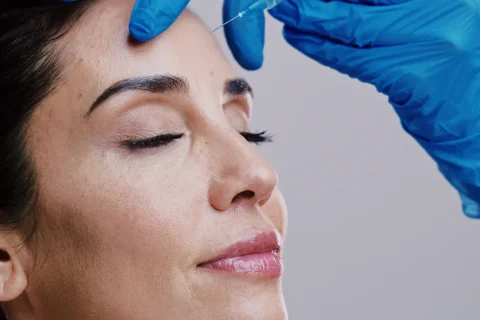
The injections: A fine-gauge needle delivers small amounts of Botox into specific points across the forehead. Most patients describe the sensation as a brief, mild pinch, and the injection process takes only a few minutes.
-
Post-treatment guidance: You will receive simple aftercare instructions, including avoiding lying flat for a few hours and skipping strenuous exercise for at least 24 hours.
-
Results timeline: Most patients begin to notice softening within 3-5 days, with full results visible at the 2-week mark. Results typically last 3-4 months.
Frequently Asked Questions About Forehead Botox Units
How many units of Botox are typically used for the forehead?
Most patients receive between 10 and 30 units of Botox for the forehead, with 10 to 20 units being a common starting range. The exact amount depends on muscle strength, forehead size, and the level of correction desired.
Does the number of Botox units for the forehead vary by person?
Yes, dosage varies significantly from person to person. Factors such as muscle mass, forehead size, skin laxity, and individual aesthetic goals all influence how many units are appropriate, which is why a personalized consultation is essential.
Is more Botox better for forehead wrinkles?
Not necessarily. Higher doses create more complete muscle relaxation, but they also increase the risk of brow heaviness if not applied with precision. Starting with a moderate dose and adjusting at a follow-up is often the most effective approach.
Can too many units of Botox cause a heavy or droopy brow?
Yes, over-treating the frontalis muscle can reduce its ability to lift the brow, causing it to appear lower or heavier. This is a temporary effect that resolves as Botox wears off. Choosing an experienced, board-certified provider significantly reduces this risk.
How long do forehead Botox results last?
Forehead Botox results typically last 3-4 months. Some individuals metabolize the product more quickly, while others enjoy results for up to 5 months. Regular maintenance treatments help sustain your results over time.
Are Botox units for the forehead different for men and women?
Generally, yes. Men tend to have larger, stronger frontalis muscles and often require 20 to 30 units compared to the 10 to 20 units commonly used for women. Your provider will assess your individual muscle activity rather than relying solely on gender as a dosing guide.
How do I know the right amount of Botox for my forehead?
The only reliable way to determine the right dosage is through a professional in-person consultation. An experienced injector will assess your muscle strength, movement patterns, brow position, and goals before recommending a specific unit count.
Great Skin, Made Easy at SkinLab Ashburn
If you are ready to address forehead lines with a treatment that fits your lifestyle and delivers genuinely natural-looking results, SkinLab Ashburn is here to help. Led by board-certified plastic surgeon Dr. Fadi Nukta, M.D., FACS, our team combines clinical expertise with a warm, efficient approach designed for busy professionals. Most appointments are completed in under an hour, so you can get back to your day feeling refreshed and confident. Visit us at 44725 Thorndike St, Ashburn, VA 20147, or call 703-914-3605 to schedule your consultation. Great skin, made easy, starts here.
Can you exercise after getting Botox? The short answer is yes, but timing matters, and jumping back into an intense workout too soon can affect how…
What not to do after Botox® matters just as much as the treatment itself when it comes to seeing smooth, natural-looking results. A few simple…