
Dysport vs Botox – The Complete Guide
Key Takeaways
- Both Dysport and Botox are FDA-approved neurotoxins that relax facial muscles to smooth fine lines and wrinkles.
- Dysport typically shows results in 2 to 3 days, while Botox generally takes 3 to 7 days for visible changes.
- Dysport spreads more broadly, making it well-suited for larger treatment areas like the forehead, while Botox offers more precise, localized results.
- Both treatments last approximately 3 to 4 months, and results can improve with consistent maintenance appointments.
- The best choice depends on your unique anatomy, treatment goals, and the recommendation of a qualified provider. At Nova Skin Lab in Ashburn, Virginia, our team helps you find the right fit.
Two Trusted Treatments, One Important Decision
If you have been researching wrinkle-relaxing treatments, you have likely come across both Dysport and Botox. These two names come up constantly, and for good reason. Both are proven, FDA-approved options that millions of people rely on each year to maintain a refreshed, natural-looking appearance. But understanding the differences between Dysport vs Botox can help you walk into your consultation feeling informed and confident.
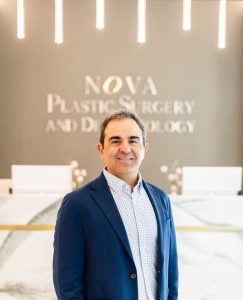
At Nova Skin Lab in Ashburn, Virginia, we offer both treatments under the guidance of our founder, board-certified plastic surgeon Fadi Nukta, M.D., FACS. Whether you are new to injectables or simply curious about switching things up, this guide covers everything you need to know.
How Dysport and Botox Work
Both Dysport and Botox belong to the same family of treatments: botulinum toxin type A. They work by temporarily blocking the nerve signals that cause targeted facial muscles to contract. When those muscles relax, the overlying skin smooths out, softening the appearance of dynamic wrinkles, which are the lines formed by repeated facial expressions like squinting, frowning, or smiling.
Think of it this way: every time you raise your eyebrows or furrow your brow, the underlying muscles are firing. Over time, those repeated movements etch lines into the skin. Neurotoxin treatments interrupt that cycle, giving the skin a chance to rest and recover its smooth appearance.
Neither treatment removes volume or restructures tissue. For patients who want to address volume loss alongside wrinkle reduction, dermal fillers can be an excellent complement to either Botox or Dysport.
Key Differences in Formulation and Spread
While Dysport and Botox share the same core mechanism, their formulations are not identical, and those differences matter in practice.
Protein size and diffusion: Dysport has a smaller protein molecule, which means it tends to spread more broadly after injection. Botox, by contrast, stays more localized to the injection site. This is not a flaw in either product. It is simply a characteristic that skilled injectors use strategically depending on the area being treated.
Unit conversion: Dysport and Botox are measured in different units and are not interchangeable on a one-to-one basis. Approximately 2.5 to 3 units of Dysport are equivalent to 1 unit of Botox. This is why the unit count for a Dysport treatment will always appear higher than a comparable Botox treatment, even though the overall cost may be similar.
Onset time: Dysport tends to show results faster, often within 2 to 3 days. Botox typically takes 3 to 7 days for full results to appear. If you have an event coming up soon, this timing difference may factor into your decision.
Treatment Areas and Results
Both Dysport and Botox are highly effective across a range of common treatment areas. Here is how each tends to perform:
- Forehead lines: Dysport’s broader spread can be advantageous for the forehead, where a more even, natural softening across a wide surface is often the goal.
- Glabellar lines (the “11s”): Both products are FDA-approved for this area. Botox’s precision can be beneficial here for targeted correction.
- Crow’s feet: Both options work well around the eyes. Your provider will recommend based on your anatomy and desired outcome.
- Brow lifting: Strategic placement of either product can create a subtle, natural lift to the brow area.
- Lip lines and chin: Botox’s localized action is often preferred for smaller, more delicate areas where precision is essential.
- Neck bands (Platysmal bands): Both can be used to soften the appearance of vertical neck bands, often in combination with other injectable treatments.
Benefits of Dysport
Dysport has earned a loyal following among patients and providers alike. Here is what makes it a compelling option:
- Faster onset: Results can appear in as little as 2 days, making it a popular choice before events or travel.
- Natural movement in larger areas: Its broader diffusion pattern can produce a softer, more natural look across wide treatment zones like the forehead.
- Consistent results: Many patients who have used Dysport long-term report reliable, predictable outcomes with each session.
- Comparable duration: Like Botox, Dysport results typically last 3 to 4 months, with some patients experiencing longer-lasting effects over time.
Benefits of Botox
Botox remains the most recognized name in neurotoxin treatments, and its track record speaks for itself.
- Precision: Its localized action makes it ideal for smaller, more detailed areas where targeted correction is the priority.
- Versatility: Botox is FDA-approved for a wide range of cosmetic and medical uses, and its applications continue to expand.
- Extensive research history: Decades of clinical use and study mean providers have a deep understanding of how Botox behaves across different patient profiles.
- Predictable results: For patients who have found a dose and technique that works well for them, Botox offers a high degree of consistency.
Choosing the Right Option for You
There is no universal answer to the Dysport vs Botox question. At Nova Skin Lab, Dr. Nukta and our clinical team take a thoughtful, individualized approach to every injectable consultation. We believe in finding the right treatment for your face, your goals, and your lifestyle. Our facial services and injectable treatments are designed to deliver results that look refreshed and natural, never overdone.
Frequently Asked Questions About Dysport vs Botox
What is the difference between Dysport and Botox?
Both are botulinum toxin type A treatments that relax facial muscles to reduce wrinkles. The key differences lie in their formulation, spread, and onset time. Dysport has a smaller protein molecule that diffuses more broadly and tends to show results faster (2 to 3 days), while Botox stays more localized and typically takes 3 to 7 days to take full effect.
Which lasts longer, Dysport or Botox?
Both treatments last approximately 3 to 4 months for most patients. Duration varies based on individual metabolism, the area treated, and the amount of product used. With consistent maintenance appointments, many patients find their results last longer over time, regardless of which product they use.
Is Dysport better for larger treatment areas?
Dysport’s broader diffusion pattern can make it a strong choice for larger areas like the forehead, where an even, natural spread is often desirable. For smaller, more precise areas, Botox’s localized action may be preferred. Your provider will recommend the best option based on your specific anatomy and goals.
How soon will I see results with Botox or Dysport?
Dysport results can appear in as little as 2 to 3 days. Botox typically takes 3 to 7 days for the full effect to develop. Both treatments continue to settle over the first two weeks, so your final result is best assessed around the two-week mark.
Can I switch between Botox and Dysport safely?
Yes, switching between the two is generally safe and is something many patients do over the course of their treatment history. Because the unit measurements differ, your provider will adjust the dosage accordingly. It is always a good idea to discuss any switch with your injector so they can tailor the treatment to your history and goals.
Why Choose Nova Skin Lab for Dysport and Botox in Ashburn, Virginia?
At Nova Skin Lab in Ashburn, Virginia, great skin is made easy. Our practice is led by board-certified plastic surgeon Fadi Nukta, M.D., FACS, bringing surgical-level precision and clinical expertise to every injectable treatment we offer. Whether you are considering Dysport, Botox, or a combination approach, you will receive a personalized consultation and a treatment plan built around your unique goals.
We understand that your time is valuable. Most of our injectable treatments are completed in under an hour, so you can fit a session into a busy workday and get back to your life with minimal interruption. Our team is here to answer every question, address every concern, and help you feel completely confident in your decision.
Ready to find out which treatment is right for you? Contact Nova Skin Lab today at 703-914-3605 or visit us at 44725 Thorndike St, Ashburn, VA 20147 to schedule your personalized consultation. Explore our full range of medspa services and take the first step toward a more radiant you.

What not to do after Botox® matters just as much as the treatment itself when it comes to seeing smooth, natural-looking results. A few simple…

Understanding how long Botox takes to work is one of the first questions patients ask when considering treatment at SkinLab Ashburn in Virginia.…